Efficient and reliable processing of biological samples is essential in modern analytical workflows, particularly when dealing with complex matrices such as blood, serum, and urine. MonoSpin solid phase extraction (SPE) spin columns from GL Science combine the unique properties of silica monoliths with centrifugation-driven operation to streamline the isolation, purification, and concentration of analytes. This approach delivers high speed, reproducibility, and robustness, offering a versatile solution that outperforms traditional packed-bed formats. In this article, we explore how MonoSpin works, its available formats and chemistries, and key applications that demonstrate its capabilities.
Principles of MonoSpin Technology
MonoSpin’s performance originates from its silica monolith – an integral silica gel synthesised from ethyl silicate. Unlike particle-based SPE columns that rely on sorbent packing and frits, monoliths feature continuous, uniformly distributed pores, providing both through-pores which support rapid solvent flow under centrifugation and mesopores which provide extensive surface area for analyte retention and interaction.
This dual-porosity structure enables high permeability and efficient mass transfer, improving flow characteristics without compromising extraction performance. As a result, MonoSpin achieves high recovery and reproducibility even when processing complex biological matrices that typically present challenges such as viscosity and particulate load.

Figure 1: Silica monolith structure used in MonoSpin
Silica monolith technology offers several technical advantages when compared to traditional particle-type sorbents commonly used in SPE:
- Fritless design: The disk-shaped monoliths eliminate the need for frits, reducing backpressure and the risk of clogging when working with viscous biological samples.
- Enhanced efficiency with small volumes: The extensive surface area allows for complete retention and elution of analytes, even from small sample volumes, improving recovery.
- Rapid processing – High permeability speeds up diffusion and solvent flow, enabling faster extractions without sacrificing recovery.

Figure 2: Comparison of MonoSpin to traditional particle filled SPE with frits
A Format for Every Workflow: Chemistries and Configurations
To support a broad spectrum of analytical challenges, the MonoSpin product line is available in multiple chemistries, covering all major interaction modes:
- Reversed Phase: C18, C18 FF, Ph
- Ion Exchange: SAX, SCX, C18-AX, C18-CX, CBA
- HILIC: NH2, Amide
- Affinity: PBA, ME, TiO, Phospholipid, Trypsin HP
- Antibody Purification: ProA, ProG, ProL
This diversity enables MonoSpin to support applications ranging from small molecule extraction and peptide purification to targeted protein capture and rapid trypsin digestion.
To support varying sample volumes and throughput requirements, MonoSpin is available in three formats: MonoSpin S, MonoSpin L, and a 96-well plate configuration. Key specifications are summarised below:

MonoSpin S
Disk size: 4.2 O.D. x 1.5 mm
Sample volume: 50-800 µL
Elution volume: 50-800 µL
Centrifugation speed: 2,000-10,000 x g

MonoSpin L
Disk size: 9 O.D. × 3 mm
Sample volume: 0.5-8 mL
Elution volume: 0.5-8 mL
Centrifugation speed: 1,000 x g

MonoSpin96 Well Plate
Disk size: 4.2 O.D × 1.5 mm
Sample volume:~800 µL
Elution volume: 100-800 µL
Centrifugation speed: 2,000-10,000 x g (centrifuge; can also be used in vacuum aspiration)
Figure 3: Comparison of the MonoSpin formats
Application Spotlight: Trace Analyte Enrichment of Catecholamines with MonoSpin PBA
The high permeability and efficient mass transfer of the monolithic silica matrix make MonoSpin particularly effective for the purification and enrichment of trace-level analytes. Its fritless monolith design supports the use of small elution volumes, enabling improved sensitivity and lower detection limits in downstream analysis.
A representative application is the extraction of catecholamines from serum using MonoSpin PBA (phenylboronic acid). As shown in Figure 4 by reducing the elution volume from 500 µL to 50 µL a 10-fold enrichment is observed. The centrifugation-driven workflow streamlines sample handling, reduces processing time, and delivers consistent, reproducible performance across low-abundance targets.

Figure 4: Purification of catecholamines using MonoSpin PBA
Application Spotlight: Fast Protein Digestion with MonoSpin Trypsin HP
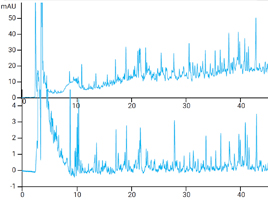
The MonoSpin Trypsin HP variant demonstrates the versatility of monolithic SPE technology in proteomics, providing a rapid and efficient platform for enzymatic digestion. Its fixed-bed monolithic structure enhances enzyme–substrate interaction, enabling proteins such as Bovine Serum Albumin (BSA) to be digested in as little as 10 minutes – significantly faster than conventional in-solution methods. This accelerated workflow maintains reliable sequence coverage and reproducibility, making MonoSpin Trypsin HP particularly well suited to time-sensitive proteomic studies and high-throughput environments.

Figure 5: Demonstration of faster protein digestion using MonoSpin Trypsin
Conclusion
MonoSpin demonstrates how monolithic silica SPE can improve the efficiency, reproducibility, and speed of sample preparation. Its fritless design, high permeability, and large surface area enable rapid processing and effective enrichment, even from small sample volumes. From trace analyte extraction to fast protein digestion, these spin columns support a wide range of analytical workflows. By combining functionalised monolithic silica with simple centrifugation, MonoSpin offers a robust and flexible sample preparation solution for modern laboratories across proteomics, metabolomics, and routine analysis.
For guidance on selecting the right MonoSpin product for your specific workflow, please contact our technical support team.
Resources