Introduction
Per- and polyfluoroalkyl substances (PFAS) have emerged as a global environmental and public health concern due to their persistence, mobility, and potential toxicity. These compounds, popularly known as “forever chemicals”, are synthetic, fluorinated carbon chains with various terminal groups, typically carboxylate, sulfonate, and phosphate.

Figure 1: PFAS chemical structures, perfluorooctanoic acid (PFOA) and perfluorooctanesulfonic acid (PFOS)
Depending on carbon chain length, PFAS are broadly classified as:
| Ultra-Short Chain (USC) | C1 - trifluoromethyl sulfonic acid (TFMS), C2 - trifluoroacetic acid (TFA), perfluoroethane sulfonic acid (PFEtS), C3 - perfluoropropanoic acid (PFPrA), perfluoropropane sulfonic acid (PFPrS) |
| Short-Chain | Include C4 to C6, such as perfluorobutanoic acid (PFBA), perfluorobutanesulfonic acid (PFBS), perfluorohexanoic acid (PFHxA) |
| Long-Chain | C7 and above, including perfluorooctanoic acid (PFOA), perfluorooctanesulfonic acid (PFOS), and higher |
PFAS and their degradation products are widely detected in surface water, soil, biota, and foods. Bioaccumulation and toxicity have been documented for several of these substances, prompting increasingly stringent regulations:
- The US EPA has established maximum contaminant levels (MCLs) for PFOA and PFOS at 4 ppt in drinking water, with additional compounds under review [1]
- The EU Drinking Water Directive (2020/2184) mandates monitoring 20 PFAS at 0.10μg/L, and total PFAS at 0.50μg/L [2]
- In February 2026, the UK government published a comprehensive PFAS Plan. UK REACH will become the main regulatory mechanism for PFAS from 2027 [3]
- Many guidelines are expanding the list of target analytes to include USC and short-chain PFAS due to prevalence and health concerns
Analytical Challenges
PFAS are typically present at ng/L or sub-ng/L levels, requiring very sensitive analytical methods. RP-LC-MS/MS is the gold standard, although there are variations in methodology:
- SPE pre-concentration prior to LC-MS/MS analysis, as in EPA 537.1, EPA533 [4], ISO 21675 [5], and similar protocols.
- Direct injection of large sample volumes, like EPA 8327 [6], for high throughput and screening power.
PFAS contaminants are ubiquitous in the lab: plastic containers and caps, PTFE tubing, seals, septa, pipette tips, etc., can potentially leach PFAS. All these should be replaced by PFAS-free certified alternatives where possible.

Figure 2: Background spectral contamination caused by fluoropolymers in conventional LC system (red) and cleaner background after modifying LC system with PFC-free kit. Agilent 1290 Infinity II with 6550 G-TOF MS [7]
Additionally, each class of PFAS brings its own set of chromatographic challenges.
USC and short-chain PFAS tend to exhibit poor retention in reversed phase. Conventional C18 columns can rarely resolve them, while phenyl-hexyl and charged-surface C18 are much better suited. HILIC and mixed-mode columns improve the retention of these compounds, but struggle with long-chain species.
Long chain PFAS, on the other hand, can be strongly retained on C18 columns and are susceptible to peak tailing. All PFAS, but especially long-chain species, can adsorb on glassware, plastics, and active metal surfaces, causing analyte loss and poor reproducibility.

Figure 3: PFAS Analysis on Zorbax Eclipse Plus C18 1.8μm 3.0 x 50mm. Notice USC PFAS are not resolved and there is visible tailing on long-chain congeners. Adapted from [8]
Finally, delay columns have become indispensable for robust and sensitive quantitation. Installed immediately before the injector, these short columns scavenge PFAS from the eluent or delay them to discriminate sample PFAS from background contaminants.

Figure 4: Overlap of sample TFA with system background TFA. The Poroshell PFAS Delay Column delays contaminant TFA and provides a clean baseline. Adapted from [9]
Altura Poroshell 120 PFAS
These requirements and challenges were carefully weighed during the development of the new Agilent Altura Poroshell 120 PFAS column.
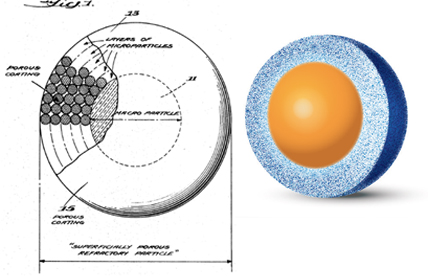
Based on Poroshell 2.7μm superficially porous particle (SPP) technology, Altura Poroshell PFAS incorporates a proprietary stationary phase designed for USC, short, and long-chain PFAS:
- Enhanced retention of USC and short-chain PFAS
Finely tuned to improve retention, peak shape, and resolution of C1-C3 - High resolution for long-chain PFAS
Fast mass transfer and optimal pore size (120Å)
Monodisperse particles for low backpressures in high-throughput applications

Figure 5: Comparison between conventional C18 columns and Altura Poroshell PFAS. Notice the clear retention improvement for C1-C3 and better separation of short-chain PFAS. Adapted from [9]
Altura is the new range of deactivated Agilent HPLC columns, where chemical vapour deposition (CVD) technology -similar to Ultra Inert (UI) in GC columns- is applied to stainless-steel column hardware. The CVD treatment coats the metal with an inert layer that completely blocks active sites, preventing the adsorption of PFAS and minimising nonspecific binding.

CVD is especially effective at coating porous surfaces, making it ideal for deactivating column frits, the primary source of unwanted interactions with sensitive analytes.
Chromatographic Performance
Altura Poroshell 120 PFAS demonstrates superior chromatographic performance across a range of key metrics:
- Better retention and peak shapes for ultra-short chain PFAS (C1-C3)
- Outperforms conventional C18 and competes favourably with mixed-mode and phenyl-hexyl
- Consistent retention times, supporting routine analysis and facilitating method transfer
- Single-injection screening for C1 to C18 avoiding method switching and extra runs
- Low backpressure compatible with standard HPLC systems

Figure 7: Simultaneous analysis of C1-C18 PFAS on Altura Poroshell PFAS column. Adapted from [9]
Altura Poroshell 120 PFAS columns have been validated against EPA 533, 537.1, 1633, ISO 21675, and the EU Drinking Water Directive. They tolerate large aqueous injections with minimal solvent effects.
Recommended Analytical Configuration
Altura Poroshell 120 PFAS analytical columns provide optimum performance with Poroshell PFAS Delay columns and a PFC-free system kit:

Figure 8: PFBA leached from system components overlaps PFBA signal from the sample. The Poroshell PFAS Delay Column provides a clear separation between sample PFBA and system background. Adapted from [9]

Figure 9: PFHpA blank and sample injections on conventional LC and LC system with PFC-free kit. Adapted from [10]
Combining the Altura Poroshell 120 PFAS column with a matching Poroshell PFAS delay column and a PFC-free HPLC system, you are equipping your laboratory with the ultimate analytical platform.
By enabling accurate, precise, and sensitive quantitation of C1 to C18 PFAS in a single injection, Altura Poroshell 120 PFAS empowers your laboratory to meet existing and upcoming regulatory requirements with a single-column solution, helping you streamline protocols, maximise throughput and efficiency, and minimise running costs.
Watch our video to hear Josep Serret explain how Altura Ultra Inert HPLC Columns are redefining HPLC performance.
References
[1] www.epa.gov/pfas
[2] eur-lex.europa.eu/eli/dir/2020/2184/oj/eng
[3] www.gov.uk/government/publications/pfas-plan
[4] www.epa.gov/pfas/epa-pfas-drinking-water-laboratory-methods
[5] www.iso.org/standard/71338.html
[7] Recommended Plumbing Configurations for Reduction in Per/Polyfluoroalkyl Substance Background with Agilent 1260/1290 Infinity (II) LC Systems (2017) available at: www.agilent.com/cs/library/applications/5991-7863EN.pdf
[8] Analysis of Per/Polyfluoroalkyl Substances in Water Using an Agilent 6470 Triple Quadrupole LC/MS (2017) available at: www.agilent.com/cs/library/applications/5991-7951EN.pdf
[9] Simultaneous C1–C18 PFAS Analysis in Drinking Water by Large-Volume Direct Injection Using an Altura Poroshell 120 PFAS Column (2026) available at: www.agilent.com/cs/library/applications/an-c1-c18-pfas-analysis-drinking-water-altura-poroshell-120-pfas-5994-8895en-agilent.pdf
[10] Reduce PFAS Background with the Agilent PFAS Analysis HPLC Conversion Kit (2026) available at: www.agilent.com/cs/library/technicaloverviews/public/technicaloverview-pfas-background-reduction-pfc-free-hplc-conversion-kit-5994-2291en-agilent.pdf